


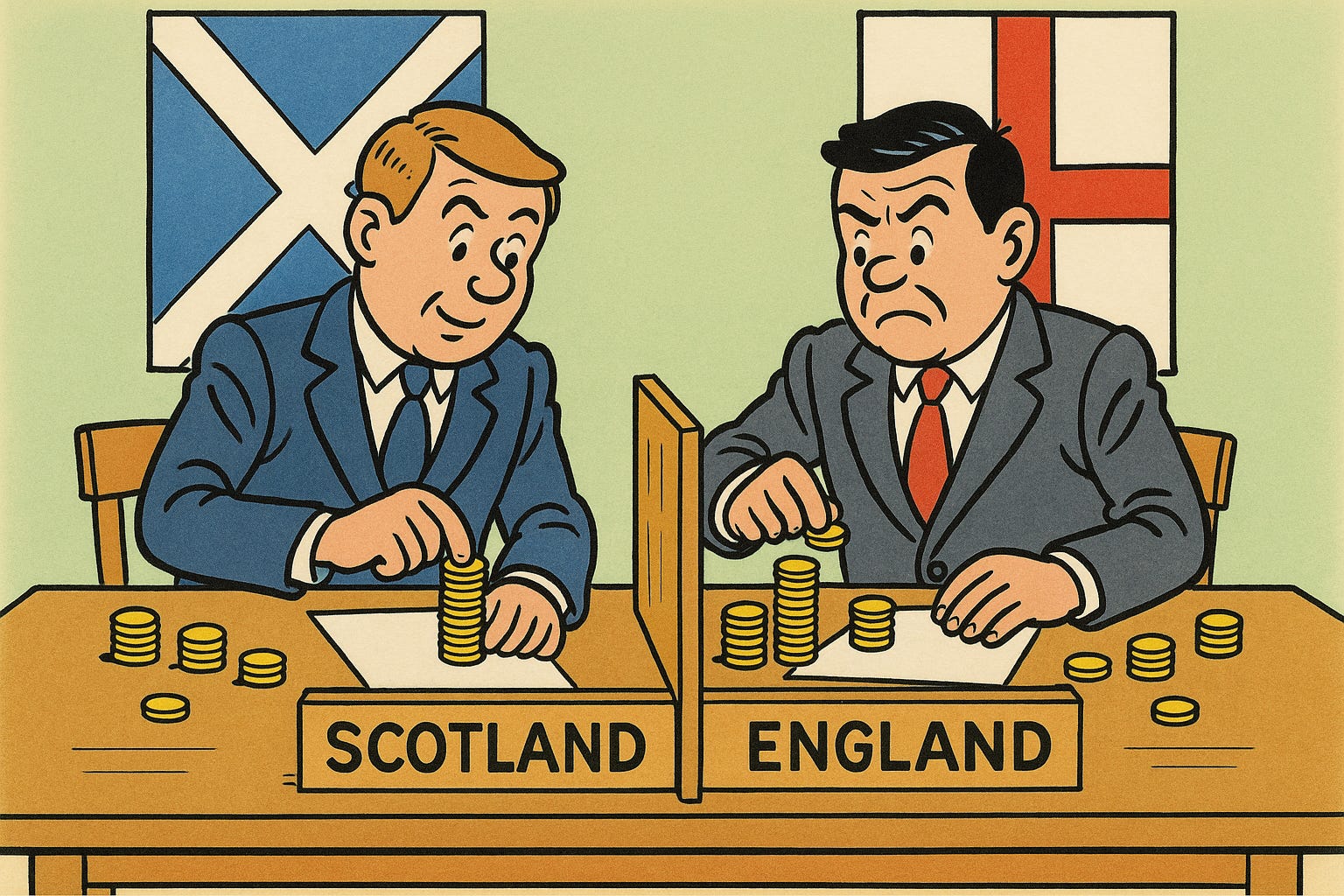
There are sound reasons for not adopting “Scotland as a colony” position. One is that unionists just don’t believe it. A colony does not, as the majority of people in Scotland did in 2014, reject independence. Those who made that decision did not see themselves in the category of a colony, but in the context of two states having created a unified state. This is why they call themselves unionists.
The political fact of England and English state interests dominating the new state formed in 1707, does not, in the unionist mind, alter the legal fact of a union. How do I know that? Because I talk to unionists, and read and listen to what they say.
Given that to win independence we have to win over a substantial number of unionist voters, there is no chance of doing so if we insist they see Scotland as a colony, because they will not accept that argument.
But there is another substantive reason, not a political one, for not adopting the colony case: assets. When a colonial power and a colony split, neither makes any claim to the public assets of the other. They simply depart and go their own way with the exception of minor agreements on pension provision for public servants.
If, however, we see Scotland as having been a state that, along with another state, dissolved to create a new single state, which has lasted for 318 years, then the matter of public assets, how they are valued, and how they are distributed on the dissolution of that old state, becomes a vital part of the break-up negotiations. As, also, does the issue of liabilities.
The British state has embassies and consulates all over the world. Many with substantial real estate value. Scotland as having been part of that state has a call on a proportion of those values on departing the union. On the English and Scottish parts of the island of Gt. Britain, the British state has military establishments and land; there are in England government buildings with real estate value, to which Scotland has contributed. One of those buildings, among others, is Lancaster House, a ripe bit of real estate slap in the middle of London. To it we may add the Foreign Office, Treasury, Bank of England, Downing Street, Cabinet Office, MOD and a number of other offices. Having contributed to their building and upkeep we are entitled to a proportionate share of their value. There are other areas in which Scotland’s negotiators will have a legitimate claim, such as the Royal Navy fleet and military equipment.
Not to be forgotten is the British States’ vast collection of valuable paintings and other artistic items gathered over the past 318 years. That will include what today has notionally belonged to the Monarch. As a recent investigative article in the Daily Telegraph has revealed, no one is sure which paintings belong to the King and which are actually state owned. An audit will be required there.
Between the day independence is won in the ballot box and independence is declared, there will be a transition period during which negotiations will take place on a new treaty between Scotland and England. Assets and liabilities will have to be defined, then divided. What I have mentioned probably only scratches the surface of all that is British state owned, to which on departure Scotland is entitled to a proportionate share of the value.
Outside of assets and liabilities there are other crucial issues that will have to be negotiated on trade relations, technical standards, the border, how freely people can move from one country to the other, and possible shared action in a Nato context.
At present, it may seem premature to be talking about independence negotiations and a treaty when we are at only 47% in the polls. The priority is surely to build the vote to an unimpeachable winning number? Of course that is the priority. But it is wise to start now building the brief our negotiators will need when we do win, rather than to wait until we win as was the case in 2014 when no work had been done.
We can start that necessary work without deflecting from the main effort of campaigning to build the vote with an independence manifesto. What we need on the negotiating brief is a few people who can draw upon expertise in the areas that will need negotiation, and start quietly but effectively on that brief project. Later this month I am meeting a key person whom I hope to persuade to take on this task.

1) Whether people believe Scotland is a colony or not does not change its status. When a territory displays all the markers that define a colony, then that territory is a colony. Generations of Scots have been conned into believing Scotland entered the 1707 Union as a wiling partner. It did not.
2) Likewise whether the people of a colony vote for independence or not again does not affect its status as a colony.
3) There is credible evidence that the 2014 referendum was rigged by Perfidious Albion through the simple process of erasing, changing, or manufacturing postal votes. They had the means to do this and it is most likely they did.
4) When Scotland is designated an NSGT, the people will be able to decide their own future in a vote free from interference by Westminster.
I think this argument of Jim Sillers is shameful, especially as he cannot give any reason with evidence when pressed on the point. His answer in his words to this question was “because I don’t believe it and neither do other people I know” Internationally, peoples from countries can see the situation we are in but Jim Sillars would like us to ignore these facts because of unionists. In his mind it’s more important to convince them. No it certainly isn’t Jim. We have been lied to and misled by the British government for centuries, our country has been plundered and we are now in an energy industrialisation. We have nearly lost our National languages with the forcing of anglophone through schools and institutions and he thinks we should not confront what our situation is. I think he is refusing to take off the blinkers and his involvement in the current Scottish parliament setup has coloured his ability to see outside of the devolutionary spectacles. My answer to him is we are United by one thing and that is that we are most definitely England’s colony. Everyone in Scotland needs to understand the reality of the situation. We don’t need to convince anyone they need the reality of our situation.