


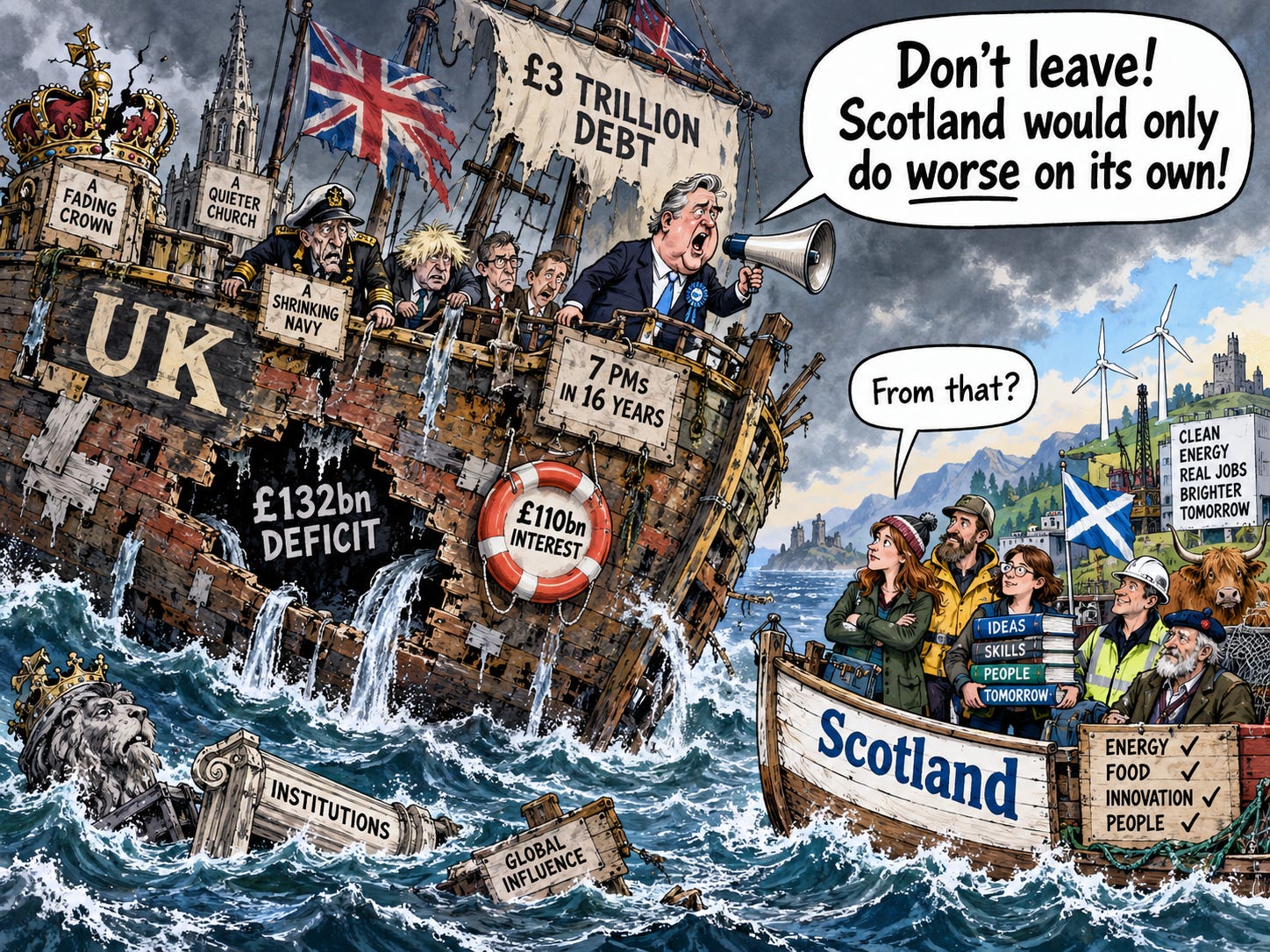
Post-imperial decline: the final stages
The Scottish Tories have launched a campaign to “slam the door” on separatism, that is independence. Underpinning this campaign is delusion. Russell Findlay, Tory leader stated: “I would urge all those proud Scots who value our place at the heart of a strong United Kingdom to back our campaign.”
Leaving aside if the 60m people in England agree with him on the Scottish 5m being the beating heart of the UK body politic (doubtful), the delusion lies in that word “strong”.
The tragedy of the UK’s political class, and the people who are guided by them, is that they have never understood the phenomenon of post-imperial decline. As chunks of the empire departed, the mentality of the centre did not change. It still saw, and continues to see, and proclaim, that the British state is one of the world’s powerful economic and political forces, exercising great influence in world affairs. That is balderdash, as the real-world powers now understand.
In the days of Empire there was in the Uk great indigenous economic strength, and an immensely strong institutional framework making it work. Today, in the final stages of post-imperial decline, it is the opposite.
The crumbling institutions tell the tale
The institutions are crumbling. The Monarchy is now fodder for the tabloids need for gossip. The Church of England, an institutional pillar, is in crisis – parishes with no vicars, churches with few attendees, and led by a woke joke. The military a shadow of a shadow of its formal self. The army cannot afford basic exercises. No one mentions the formidable RAF because all know it isn’t. The Royal Navy is short of ships and sailors. Retired Real Admiral Philip Mathias has pointed to the shortage of submarine commanding officers, because those who should be up and coming at that level are stymied due to “shockingly low levels of submarine availability, partly due to the lack of maintenance facilities meaning that junior officers have been prevented from gaining sea-going experience.” Serving Admirals are bewailing the shortage of surface ships.
The Police are in the same state as the armed forces. The criminal justice system is gummed up; and those it does get around to jailing have to be let out early because the prison system cannot cope. The civil service, once renowned throughout the world as a Rolls Royce organisation now places more emphasis on working from home than delivering public services.
The Economy of the UK cannot sustain the welfare state
Then there is the economy and the welfare state. An economy creates wealth and the welfare state eats it. How sustainable the welfare state is depends upon how robust in growth the economy is. A key part of the welfare state is the state pension triple lock. The affordability argument around that at present is instructive. The triple lock has improved pensioner income, but it would be difficult to describe the new state pension of £12,547.60 as generous. If the triple lock, the fruit of which is one of the lowest state pensions in Europe, is unaffordable, then it doesn’t say much for the economy that supports it.
The UK: A poor country that can no longer avoid that truth
The fact is that far from being “strong”, the UK is skint. It doesn’t earn what it spends. The 2025-26 budget deficit - the difference between what it took in taxes and what it spent – was £132bn. That money was borrowed, and then added to the money already borrowed, taking the national debt to nearly £3 trillion. Borrowed money has a cost. Last year the UK paid £110bn in debt interest.
Russell Findlay may be able to look but not see the true state of the Uk economy, but those who lend to governments, which the business sections of newspapers call “the markets”, are not so blind. The UK is now unique in the bond market as those who lend to it extract what they call “the moron premium”, which is an additional percentage from what they charge other developed countries. In short in both 10 year and 30 year bonds, the UK pays more than other countries because bond buyers recognise a UK weak growth, inflation-biased economy which is far from “strong”.
Then there is the politics. There is a relationship between politics and the economy. One of the important contributions politics makes, which is an anchor of economic development, is stability. It has delivered anything but. Nothing better describes the sharp decline of the UK than that in the 16 years since Gordon Brown left Downing Street in 2010, there have been 7 Prime Ministers in Downing Street.
True state of the UK strengthens the case for Independence
Russell Findlay’s campaign presents an opportunity for the independence movement to explain why it is in Scotland’s people’s interests to break free of a failing UK which can deliver nothing to them but decline, failure and a lower and lower standard of living.
The facts are there. They are not opinions. They are there in broad daylight from official UK and international sources. The UK has been for some time a poor country pretending to be rich. It is now a poor country that can no longer pretend to be so.
By comparison, Scotland is a country where the balance between population and resources is a perfect design for economic growth, with a robust economy, fuelled by an abundance of energy, that will be capable of generating the levels of wealth required for both our young people and elderly to experience a better life.
