

Here is the article from Catherine Macphee of Skye, that Simon Forrest referred to in his opening remarks at our Yes United Inverness meeting. "Rural not Remote" was one of the recurring messages of the day.
New cultural infrastructure is vital to stop Skye being hollowed out by holiday lets and seasonal blow-ins, writes Catherine MacPhee.
Last year, during a social media discussion about wind farms, a settler to Skye commented: “you Crofters don’t care about the island or the land.” I did not respond, though I felt the urge to cry out that they could never understand the relationship we hold with this place: a relationship carried not in ownership but in reciprocity, where the land sings through Gaelic names, stories, and memories borne across generations. What they could not see was that their very position as a so-called “hobby crofter” rests upon struggles, sacrifices, and solidarities of those who came before us.
My family history, like that of many Gaels, is marked by resistance to the colonial violence of the Highland Clearances. My family were rooted in the Glendale uprisings, in collective action against landlordism, in poetry and song that named the abuses of factors and clan chiefs who had aligned with capital over kin. This was not merely cultural loss but class war, as land was transformed from a living commons into an instrument of extraction, profit, and control. That history feels uncannily present. The policies may have become more bureaucratic, but the result is unchanged: land is a commodity, housing an investment, people expendable. What we see is not progress, but a deliberate wave of extraction, removal, and displacement. “Development” is used as cover while the communities that give this island its life are hollowed out.
Against this backdrop, I find myself in a house-share. A series of life events left me homeless at the end of 2025, and the tether binding me to this island may yet snap under the pressure of the housing crisis. That tether can feel like a chain, holding me in place, but also holding me down. Perhaps that tension is something to work through: the fear of being forced to let go of land that never was truly allowed to belong to us.
The housing market is in crisis everywhere, dominated by private rentals and lacking social housing, but it cuts deeper on an island. Here, connections are rooted in the land itself. Displacement unravels not just bodies, but language, memory, and meaning. To protect our future, we need politics rooted not in property or capital, but in relationship, community, and responsibility. Policy and practice must reflect this understanding.
Our communities are hollowed out when homes are snapped up for holiday lets and seasonal blow-ins, commodifying shelter into experience, escape, and profit. These places are marketed as “remote” and “wild,” consumed as landscapes rather than lived realities. That word – REMOTE – sidelines our communities, as if we exist at the edge of Scotland looking in. We are not remote. We are rural. Our islands are alive with Gaelic, song, tradition, and story. We are rooted in place and culture, not cut off from it. To call us “remote” is to erase our strength, our resilience, and our central role in Scotland’s identity. Naming matters. Words shape how governments act, how resources are shared, and how futures are imagined. Our culture is not peripheral, it is powerful. Our voices are not distant, they are here, loud and clear. Rural, not remote, is who we are.
The Moral Economy of Rural Life
Over the last couple of years, I’ve been involved in an effort to reject community apathy and support an open space. Common spaces to gather and welcome new people encourage good old plotting and planning. The best conversations and ideas spark over tables. This initiative began when the pub closed, which was more than just the loss of a business; it marked the unravelling of a social ecology that took generations to weave.
In island and rural communities, places of gathering are not optional extras to economic life; they are its beating heart. The pub, particularly one that hosted traditional music, functioned as a commons, where stories, songs, humour, grief, and belonging were shared. It acted as social glue, binding people across age, background and circumstance, and sustaining a sense of continuity in a place vulnerable to erosion.
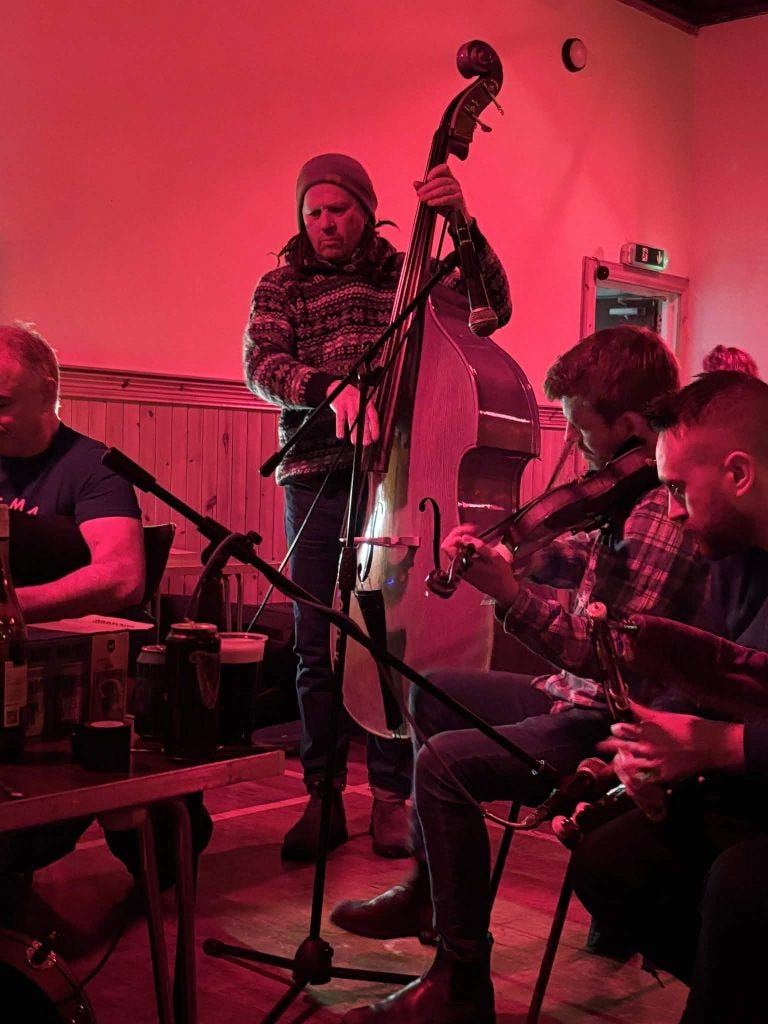
Traditional music here was not a commodity for performance. It was a living language of the land and sea, carried by those rooted in the place and offered freely in relationship. When such spaces are lost, the damage is not immediately visible on a balance sheet, but it is deeply felt in the thinning of social bonds and the quieting of cultural voice.
The takeover of businesses by those without a rooted connection to the island marks a familiar pattern in fragile rural places. Ownership without relationship risks treating the place as an asset rather than a living community. Decision-making becomes detached from local knowledge, memory, and care. The result is often a well-intentioned but ultimately extractive approach that misunderstands why people gather, spend and stay. It is unrealistic to expect people to shop, eat, and invest money in a place that no longer invests in them. Rural economic activity flows from trust, belonging, and mutual recognition. Remove the conditions that nurture these, and the economy withers, no matter how polished the offering.
This is not a call for blame, but for listening. A constructive path forward requires a shift from asking “How do we make this viable?” to “What does this place need to live?” Viability grows from vitality, not the other way around. Reopening space for traditional music, informal gathering, and local stewardship would be an act of repair. Culture is valuable not as an add-on, but as vital infrastructure for island life.
For rural communities to endure, all who care about them must step up and help build lasting change with humility and in partnership. Our idea to establish the Revolting Crofters Social Club emerged in recognition of the need for renewed gathering places. The idea also responded to the loss of the pub, and the desire to create alternatives to compulsory drinking. It grew from local projects and ongoing conversations with friends and neighbours who yearn for a welcoming, non-judgmental space to gather, connect, and collectively respond to the social challenges shaping our rural lives.
The Flame of History
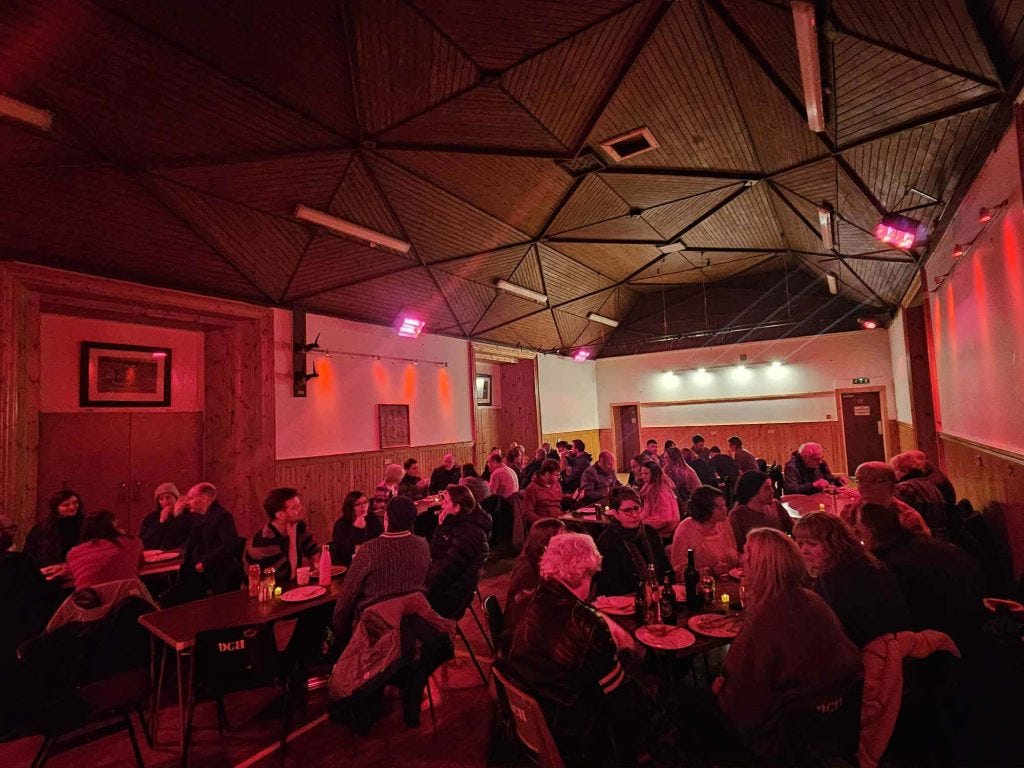
We started simply. We booked the village hall, invited local musicians, cooked food ourselves, and opened the doors. Over fifty people came. There were no expectations, just shared food, conversation, and time together. The vibrancy of the village’s once-thriving music scene had faded, but we sought to rekindle some of that energy.
Our aim is to create a regular programme of community-led events bringing together people of all ages and backgrounds. Through shared meals, live music, family activities, film screenings, and community talks, we hope to build momentum for a space that supports wellbeing, reduces isolation, and encourages grassroots action on issues like food insecurity, loneliness, and social cohesion. Our first event showed what was possible: an intergenerational gathering of long-time locals and newer arrivals, sharing space and joy. It was a beginning, and with support, it could become something lasting.
The name Revolting Crofters Social Club nods to history and hope. It draws inspiration from the Crofters’ Party — the political wing of the Highland Land League — and from the older meaning of revolting: standing up, speaking out, and refusing conditions that degrade human dignity. Skye has a long history of land resistance, protest and solidarity, and the struggles continues today. These struggles were never only about this island. They were about justice, dignity, and the right to a future. The irony is sharp. My family fought for land, housing, and cultural survival. I feel increasingly shut out of the first two.
When it comes to the third, part of our task is to stitch moments of resistance into our collective memory, not only for accountability, but so that others learn what shaped our culture. The Highland Clearances are often remembered in stark terms: violent rupture, mass eviction, exile. This narrative holds truth, especially in the most brutal phases, but it also flattens a more complex reality. Each clearance emerged from a particular configuration of landlord ideology, economic pressure, population change, and moral choice. Clearances were not uniform acts but a series of decisions whose consequences shape land ownership, housing precarity, and cultural trauma today.
To engage honestly with this history is not to dilute its injustice, but to understand it as an ongoing social transformation and to confront how enclosure, extraction, and displacement continue under new names. The promise of history is not nostalgia, but survival: the survival of ways of being human together that still have much to teach us.
Catherine MacPhee is a Sgitheanach, archivist and activist.
We so need to hear these voices. The stories need told. More power to you for rebuilding communities.
A powerful reminder of the value of learning from history, standing up against injustice and, above all, the power of social cohesion and solidarity. My wife's people were also from Glendale and reading the crofters' history is teaching us both so much. Thanks Catherine.