

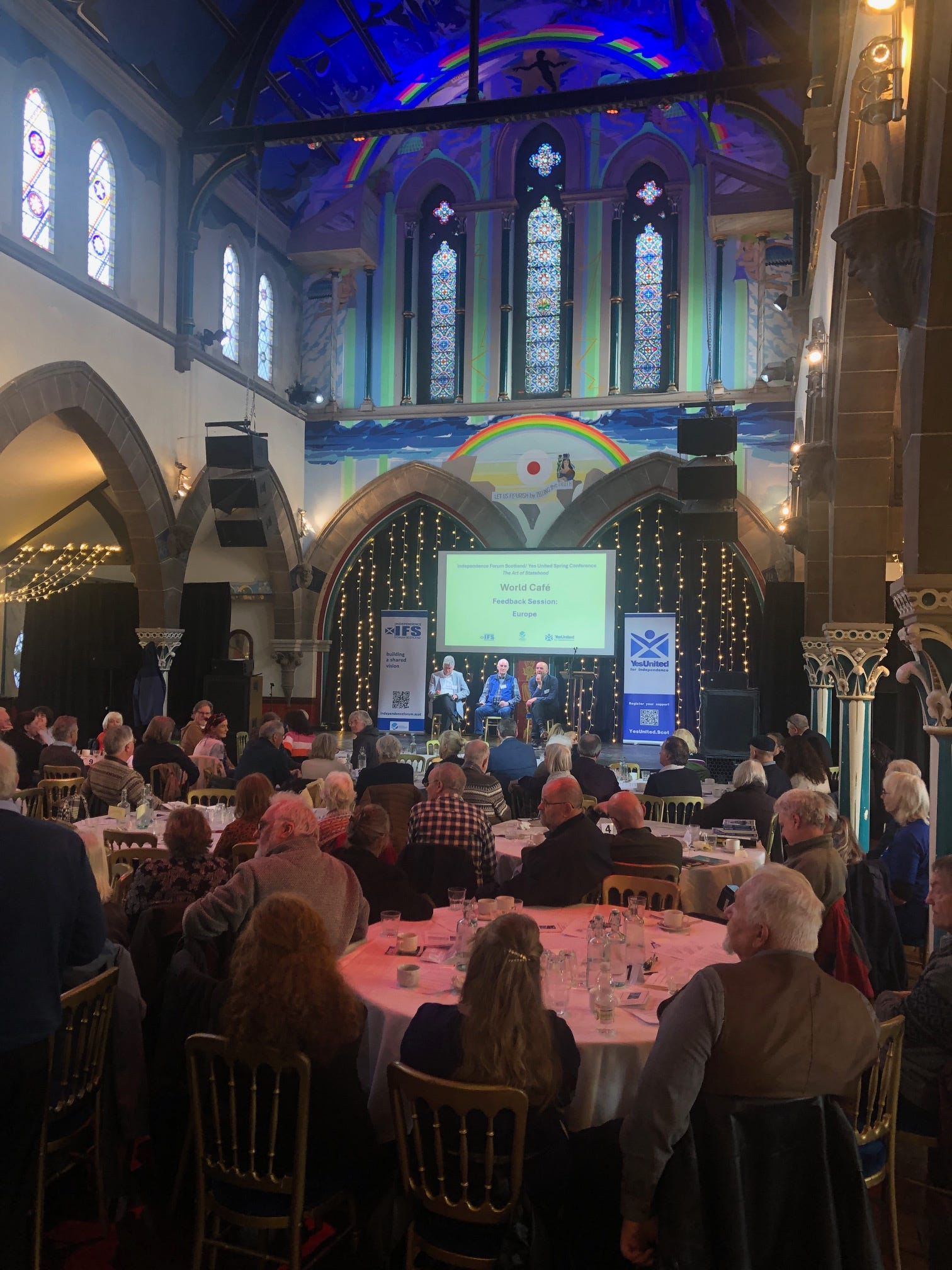
Since the Independence Forum/ Yes United Spring Conference at Òran Mòr on Saturday 14 March we’ve been pulling together the various strands of the day’s discussions at the World Cafe session, on the three topics of The Economy, Europe and Energy.
We went through the various notes collected and supplied by the nine facilitators involved, and produced a summary sheet, showing the key points which the attendees in the room contributed in each case. You can read this below.
After discussion inside and outside the organising team, we decided to hold off publishing these notes until after the election.
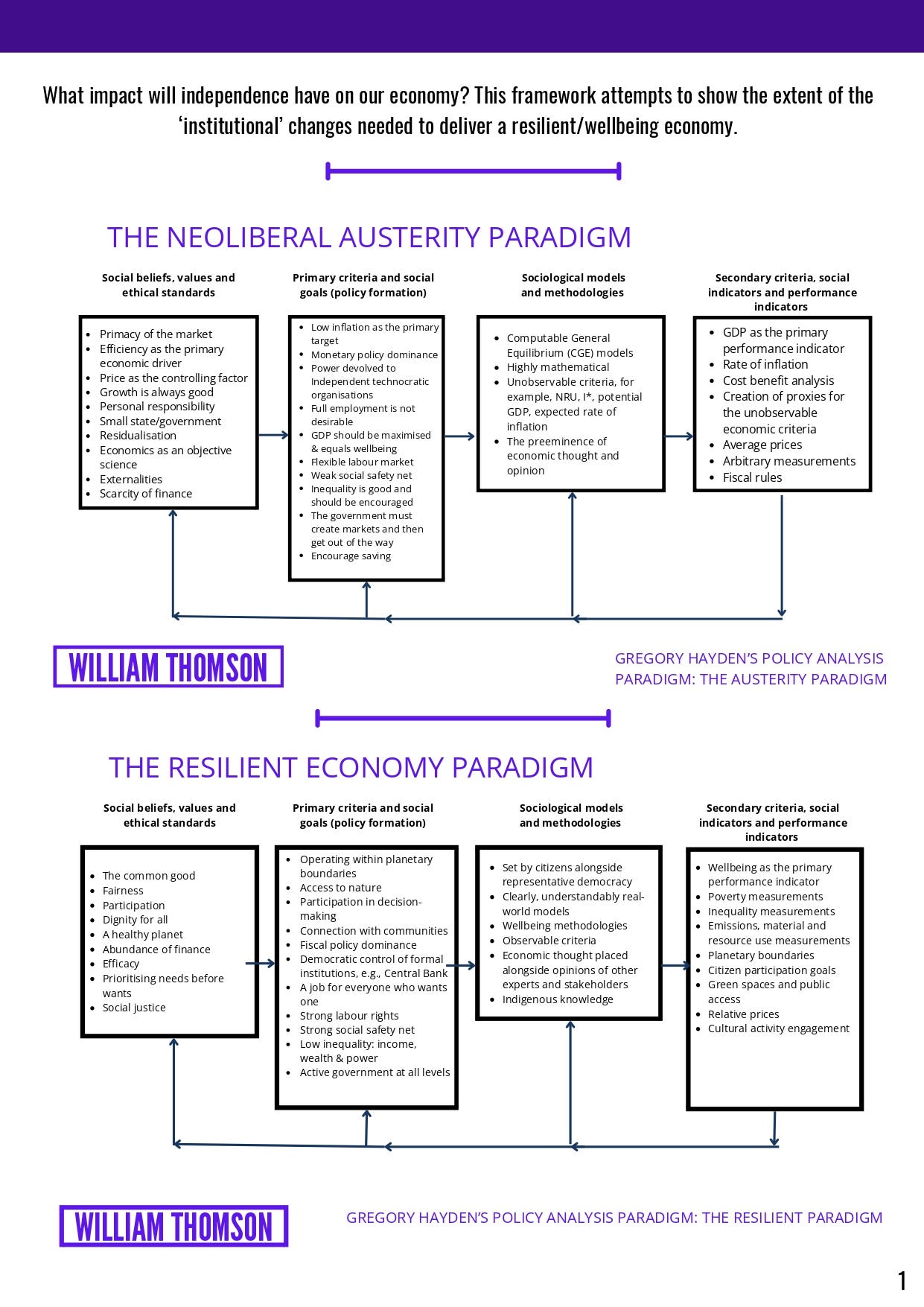
Also below is an additional sheet produced by William Thomson, one of the Economy facilitators, as a fuller explanation of what is contained in the Economy notes. It sets out the differences between the neoliberal austerity approach under which we currently live, and the resilient/wellbeing economy that was proposed in the 14 March discussions. The extent of the necessary changes is pretty eye-opening!
Finally, if you’re interested in watching them again, the videos of the three main speeches during the day are now available on the Yes United YouTube channel:
Lesley Riddoch’s opening speech, which started the day off in fine style;
Phil Boswell’s keynote speech, which set us thinking at the start of the afternoon;
Jim Sillars’ monumental closing speech, which brought the audience to its feet.
In addition, Independence Live created a video of the whole of the evening ‘Putting the Band Back Together’ concert, and has placed it on its own YouTube Channel. You can watch it here.
IFS/Yes United Spring Convention 14 March 2026 - Discussion notes
Scotland’s economy*
The current state of Scotland’s economy was described as docile and dominated by foreign owners, public sector heavy with the NHS, Public Health Scotland and councils accounting for 45% of GDP, and a weak 3rd sector i.e. charities, social enterprises and community groups delivering essential services.
The private sector is weaker now than in the past, and public companies listed on the Stock Exchange are mostly gone. Strengths are Fintech (Financial technologies), IT (Information technology), and Energy, particulary renewables, though improved grid systems are needed. Scotland is self sufficient in many areas of food production. Agriculture and fisheries generate strong export revenue streams, but Scotland’s share of the UK fishing fund is tiny compared to the size of its contribution (8% of funding for 60% of both fleet and seafood exports). Taking full control of the industry is strongly recommended.
Economic foundations
Opinions varied on how to run the economy, but there was broad consensus on Scotland’s economic foundations.
Resources - Scotland is well endowed with natural resources but an extractive economy means little benefit is retained.
Human capital - Scotland’s people are a key resource that is also extracted due to scarcity of rewarding jobs and affordable housing. Quality is high but quantity low as more, largely young, people, emigrate every year, including to England.
Infrastructure - much of Scotland’s infrastructure is foreign and privately owned. The lack of investment, in e.g. ports, transport and energy networks has allowed major assets to be run down or decommissioned.
Inventiveness and initiative - Scotland produces a wealth of talent across the arts, commercial and industrial sectors. Much of this is exported in search of business opportunites and a high standard of living.
Stepping stones to a healthy economy
Moving to a resilient, wellbeing economy requires structural change in key areas; land ownership, taxation, ownership of energy and transport (including harbours and ferry ports), and housing. The question is, what powers does the Scottish Government have now to redistribute wealth and grow the economy? Opportunities exist but action is constrained by an apparent lack of understanding of how the economy actually works. Special advisors offer continuity across elections but promote an orthodox, neoliberal agenda that favours the current extractive economic model.
Some of Scotland’s major industries are problematic and need regulation, e.g. over-processed food makes people ill, intensive agriculture destroys land, tourism takes priority over residents, property is for speculation not housing people. Manufacturing and service sectors are hollowed out by private investors. These issues can be tackled by a state sponsored development plan with local supply chains and manufacturing capacity to grow the industrial sector. Reinstating a Scottish stock exchange is also recommended.
Shifting economic models
It hasn’t always been this way. Post WW11 the UK government built a healthy economy for the good of the people. Neoliberalism began to replace Keynesian economics in the early 1970s and finally took over in 1979 when Margaret Thatcher got elected. If it took over in six years it can be dismantled in another six.
Decolonization
Whether or not Scotland meets all the criteria to be declared a colony, there is overwhelming evidence of economic colonization and colonial health syndrome is a demographic reality. ‘Social murder’ is a term used to describe the higher death rate during periods of austerity. Statistics on alcoholism, diabetes, domestic violence, drug deaths, obesity, suicide and chronic health problems speak for themselves. Only the state can intervene to protect the wellbeing of people and the economy. Educating and empowering the population are important next steps.
* Based on notes compiled by facilitators Val Brown, Tim Rideout and William Thomson
Scotland and Europe*
Scotland has geographic and historical roots in Europe. Europe is not the same as The EU in general but also particularly in relation to defence and security matters. Could Scotland also choose to be a Nordic country? Two Nordic nations are not EU members. Is this status an option for Scotland to consider? Ireland moved its European trade from via UK to direct links since Brexit. Is this a lesson for Scotland?
EU vs EFTA (European Free Trade Association)
Independent Scotland will be able to decide on future relationships within Europe. Key advantages relate to free movement of labour, capital and people, access to markets and the value of trade. EU funded infrastructure projects could benefit Scotland as they did Poland. Freedom to travel is also highly valued. Some Scots emigrated to enable continued personal association with the EU.
There is a lack of knowledge about EFTA as an alternative route to the trade advantages of the EEA (European Economic Area) and about the EU itself. EFTA and EU are not entirely incompatible, though there are problems with EU fiscal rules which EFTA does not have. Joining EFTA as a route to membership of the EU would provide faster access to trade advantages.
Scotland’s alignment with EU regulations may weaken the longer we are out of membership. Rejoining would require abolition of Scotland’s two Freeports.
Options for trade with the rest of the UK also need to be considered. Trade infrastructure must be rebuilt post independence. Why not start now?
A Rational choice
Because 62% of Scots voted Remain there is a lingering sense of emotional loss which lends itself to a conflation of rejoin the EU and independence. But is EU membership, with its restrictive ratios of deficit/debt to GDP, compatible with Scotland’s fiscal need, as a newly independent country, to invest in state building and necessary infrastructure. The EU is changing so there is no way of knowing what it will be like if and when Scotland rejoins after two referendums: 1, to apply and begin accession negotiations and 2, to accept the final deal – or not.
Europe’s influence in the world is declining both absolutely and relatively in contrast to the rise of the BRICS countries (originally Brazil, Russia, India, China, South Africa, now BRICS plus with six or so additional members).
Remaining questions
Could / would Spain veto Scotland’s membership of the EU?
Is Europe 100% democratic and does this matter? (Hungary was cited as an example but the situation there changed dramatically at the recent election.)
The bottom line
Scotland needs independence to be in a position to weigh all options and decide on future relationships with the EU, Europe, Nordic nations, rUK and the rest of the world.
* Based on notes compiled by facilitators Dave Thomson, Colin Fox and Geoff Bush
Scotland’s Energy*
Scotland has the resources and capability to maintain security of supply through a diverse, sustainable energy mix including on and offshore wind, solar and tidal with various forms of storage. Gas turbines will be required for a period of time for capacity and grid stability, but there is strong support to continue the moratorium on new nuclear plant. Nuclear power plants are expensive, take more than 10 years to build and create toxic waste. While small modular reactors might bring jobs to areas needing employment, they are only a concept with no safety licence or cost and schedule estimates. There are better options than this.
Sector control
There is strong support for the independent Scottish Government to exert operational control of electricity generation, transmission and supply. Diverse views on the nature of that control include creation of regulatory agencies such as SIREN (Scottish Independent Regulator of Energy & Networks - unanimously agreed at the IFS Convention in Perth), a publicly owned National Energy Company with control of generation and supply, and a Scottish Energy System Operator (SESO).
The desire is uniform for immediate energy market reform to ensure that Scotland’s people and industry benefit from the plentiful supply of renewable energy in and around the country. There is consensus to move away from using a volatile, internationally traded commodity (gas) to set the price of electricity. Suggestions include the use of zonal pricing.
Ownership
Community and Municipal energy projects provide a means to deliver affordable energy and allow residents to share in the benefits of local heat and electricity schemes. A proposal for the Scottish Government to create a taskforce to assist in the siting, development and construction of these schemes (also approved at the IFS Convention in Perth), offers a practical solution. The recommendation for Scottish Local Government Pension Funds to be used to support these projects (consistent with the Community Wealth Building (Scotland) Act 2026) was powerfully presented from the floor of the meeting.
Environmental impact
Concerns about the adverse environmental and visual impact of infrastructure projects proposed or under construction throughout Scotland include many in rural areas. Creation of a Scottish Infrastructure Planning Agency (SIPA) will ensure that community concerns are given due weight in the assessment of such projects.
The environmental and economic benefits of measures to improve energy efficiency in homes and buildings were noted. Such schemes and measures are already within the powers of the Scottish Government and would have greater emphasis with the enhanced fiscal freedom available in an independent Scotland.
Just transition
There were calls for clarity and urgency on the Scottish Government’s just transition plans to recognize the importance of the Oil & Gas sector to the Scottish economy. However opinions varied on the continued promotion of oil and gas in the face of the climate challenge.
Productive partnerships
The value and importance of Scotland’s educational sector was widely acknowledged with calls for the Scottish Government to support a symbiotic relationship between Universities and Scotland’s innovators in the field of energy technology through the industrial placement of technology graduates. This is viewed as a win-win-win situation.
* Based on notes compiled by facilitators, John S Proctor, Rhys Stanwix and Stuart Clements.
The full version of the Energy Discussion notes includes a range of points, some complimentary and some contradictory, as well as detailed proposals with examples for infrastructure, management, pricing and control of the sector. This summary prioritized brevity over comprehensiveness. The Energy Group Steering Committee has the full version to work with.
2. The current "compromise" of devo will increasingly be seen as a "compromise too far":
a. It Won't protect us from English Nationalism in its ugliest forms?
b. The UK is a £fiscal busted flush; the devo cookie jar will become increasingly empty?
c. We (and other parts of the UK) will get fed up being dragged into other people's wars for no obvious good reason & having to suffer the economic & other pain arising?
d. Eventually, folks will come to terms with the realisation that the SNP, whilst clearly more Scottish-focused than other UK based political parties, is potentially just as corrupt & incompetent* as those UK-based parties. However, having accepted that "adult" reality, we will still opt for independence as the correct political choice, but this time with our eyes wide open to internal & external opportunities & threats. Focus on indy?
*Forget about vain efforts to seek genuine remorseful political accountability. Whether it's the Murrell/Sturgeon stitch-ups on money, Salmond or whatever; avoidable covid deaths due to poor decision making & a limited "golden circle" of favoured advisers; ferries which don't sail...there is almost Zero chance of achieving collective & personal accountability in any meaningful form? Swinney may have to resign as FM before 2031, as a break from the SNP's murky past, but even that will be well choreographed in advance, as is almost everything else?
UK? Will there EVER be real accountability for Covid deaths; the corrupt CV contracts; the Grenfell Fire; the strangle-hold of Israel on our foreign policy etc? NO, forget it; we just don't do accountability in the modern political world? Don't confuse morality with politics; ethical values with the exercise of political power; they are different things.
Like I said, the good, the bad & the ugly. Just my subjective assessment as of today. I hope that Yes United can indeed Unite us in attaining the common goal of independence, preferably in my lifetime, and that of anybody reading this page now! (end)
William. Thanks for this useful reminder of the positive discussions which took place in March, seems a long time ago?! Below is my own entirely subjective assessment of where "we are at", taking account of all that has happened since March, & specifically since the H/R election & the events of this week. "The State of the Union: the good, the bad & the ugly?" (as at 28.5.26).
1. Scotland WILL become an independent nation at some point in the future. Exactly How, When, Why this will happen is too complex to predict. However:
a. It may/may not happen in my remaining lifetime (I am 64; older folks may be more/less optimistic according to their own timelines!?)?
b. It will happen for both Positive & Negative reasons & as part of a more general/seismic Break up of the United Kingdom; it will be Messy with, as usual, "innocent casualties"?
c. The process will involve many forms of political & other compromises with Scottish, UK & International "actors"; we may have to "sup with the devil" (initially) to get what we want?
d. Anyone who thinks we can start an independent Scotland as some form of "guaranteed ideal Nirvana State" with no nuclear weapons, telling US administration^ to p*** off & a 100% fossil-fuel free economy etc, should go away, think about it for at least ten years & come back with an alternative plan? ^ = not necessarily Donald Trump?
e. Anyone who thinks that an independent Scotland will initially be 100% free of corruption, nepotism, tribalism & self interest should repeat the process in d above?
f. Anyone who thinks that we can attain independence without sacrificing the interests of our cousins in England, most likely left to the mercy of an ugly right-wing semi-fascist English State, should repeat the process in d above?
Summary: Independence IS attainable; under certain internal & external "causes & conditions" IF the Scottish people, in sufficient numbers & with sufficient commitment/passion, Really, Really want it & are prepared to do what is necessary to get it? It will Not be a clear, easy, fair process & many unpalatable compromises may be required to attain that initial "freedom"? Once attained, we have to accept that we cannot control the future; that internal demographics/political alignments & external global forces will also impact our national destiny. There is no insurance policy; no risk free indemnity, so we should stop looking for one? The political composition of future independent Scottish Parliaments is a matter for future voters (including the not yet born) to determine; not us at one fixed moment in demographic time? Uncertainty & change is the DNA of modern society? tbc/